Thursday, July 23, 2015

West Village Weird (Part Two)

As I mentioned in Part One, I'm breaking down This Hidden City's visit to the West Village into two circled walks, with this post as the second circular walk, this time on the east side of the West Village.
With this entry, I'll begin at the northeast corner of W. Houston Street and LaGuardia Place, where there is a large lot (25' x 40' / 7.6 x 12m), which was turned into, what artist Alan Sonfist calls, "land artwork". Titled Time Landscape, the garden plot consists only of plants which are native to the island, and is meant to give New Yorkers a view of what the area looked like before the Colonists' arrival.


First proposed in 1968 by Sonfist, with the essay "Natural Phenomena as Public Monuments", the project was publicly unveiled in 1978. As you walk north along LaGuardia Pl, you can spot birch trees, beaked hazelnut shrubs, red cedar, black cherry, witch hazel, mugwort, Virginia creeper, aster, pokeweed, milkweed, oak trees, white ash, American elm trees, sassafras, sweetgum, tulip trees, arrowwood, dogwood shrubs, bindweed, catbrier vines, and violets - all planted by the artist.
When you approach Bleecker Street, begin walking westward, and you will come to the corner where Bleecker crosses 6th Street, Downing Street, and Minetta Street. Turn right on Minetta St to experience the complete opposite of Time Landscape, as this street runs over what once was Minetta Creek, a stream that was one of the largest natural waterways in Manhattan, only to be covered up.


The name is derived from what the local Native American's called it, Manette, which translates as "devil's water". Some say the creek still runs under the streets of Manhattan, while others claim the construction completely stopped its flow.
At the end of Minetta Street, make a right, and you'll almost immediately find yourself in front of one of the most happening spots in Beat and Hippie history: Cafe Wha?.


Opening in 1959, and closing sometime in the mid-60s, the joint was bought by club manager, and uncle to David Lee Roth, Manny Roth. It became a popular hangout for comedians, musicians and hipsters, such as Bob Dylan, Jimi Hendrix, Bruce Springsteen, The Velvet Underground, Woody Allen, Lenny Bruce, Bill Cosby, and Richard Pryor.
Roth sold the place in 1968 to Menachem Dworman, who ran it as Cafe Feenjon, changing the style from Beat poetry, and rock-n-roll, to falafels, and Middle Eastern music, until 1987, when Dworman's son Noam changed it back to its original name, and brought back the rock.
Head back to Bleecker St, and walk east to Wooster Street, where you'll find the Silver Towers Complex. Within their courtyard stands a huge (67 ton), two-sided, concrete sculpture of Picasso's 1954 "Bust of Sylvette" (originally inspired by beautiful 19-year-old Sylvette David).


While many think this 1968 installation is by Picasso himself, the truth is he didn't have much to do with it. It turns out that Picasso doesn't have any outdoor sculpture in the U.S., besides his 50' (15m) / 140 ton piece in Chicago. The work is actually by Norwegian sculptor Carl Nesjar, who only asked Picasso (by mail) if he could recreate it.


The most Picasso has to do with this work is that he created the small, metal original, and replied with a "yes" to Nesjar. Sadly, the plaque almost hides this fact, by placing Picasso's name larger than Nesjar's.


Speaking of phony, walk over to 85 W 3rd Street to see Edgar Allen Poe's home (from 1844 to 1846), where he was said to finish "The Raven".


Why did I write "phony"? Because this isn't his home, nor ever was.
Poe lived in the immediate area, but his house was demolished by NYU to make room for Furman Hall. Only the facade was somewhat preserved, as well as moved a block away to where it is now.


Walking east again, we come to NYU's Schwartz Plaza, which keeps their Founder's Memorial.


The top of the landmark holds the only remaining piece of the original Gothic Revival-styled building of New York University's first campus, which was built in 1835. When it was demolished in 1894, the school decided to keep the spire at its Bronx dorms. When those buildings were sold in the 1970s, the peak of the original was moved to where it is today.


Now, as if floating along Minetta Creek, cut through Washington Square Park - all the while keeping in mind that the park was once New York City's largest pauper's grave - and cross over to 2 W 5th Avenue, and you can see a plaque on the exterior of the building where Minetta Brook once poured forth.


The plaque reads:

A brook winds its erratic way beneath this site.
The Indians called it Manette or Devil's Water To the Dutch settlers it was Bestevaer's Killetje or
Grandfather's Little Creek For the past two centuries familiar to this neighborhood as Minetta Brook.

The last stop on this trek is just a hair outside the West Village, but sits just east of Washington Square Park, so I thought to include it. It is 23-29 Washington Place (between Greene Street and Washington Square East), known as the Brown Building.


Built in 1900, it was originally named the Asch Building, after its owner, Joseph J. Aschonce.
The building's top floors were once occupied by the Triangle Shirtwaist Factory, and it is the site of a terrible fire, which killed 146 garment workers on March 25, 1911.
In case you think me a little morbid in pointing this out, New York's Landmarks Preservation Foundation marks the spot with a plaque on the southeast corner.
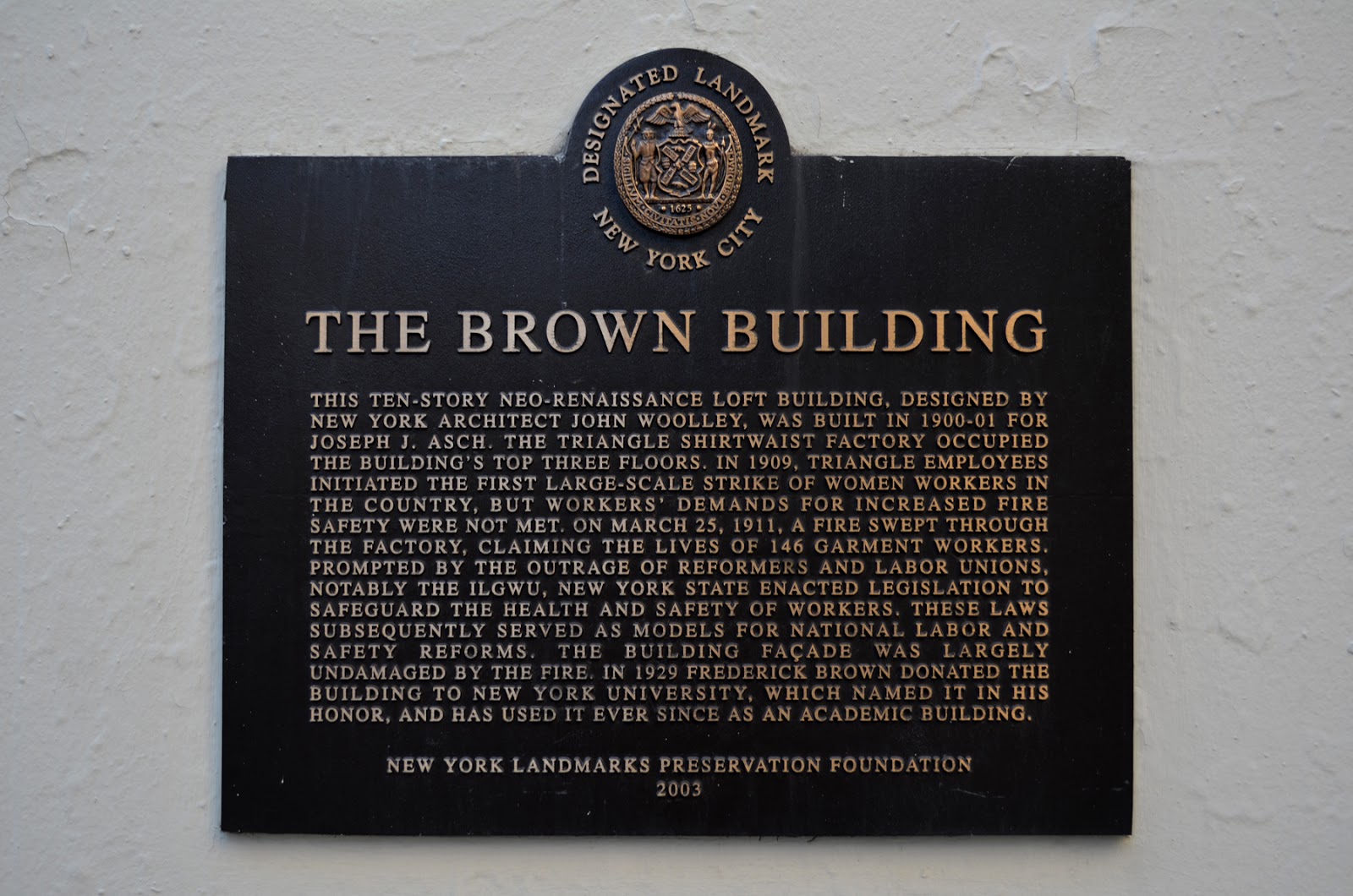

While this walk ends on a sad note, do know that the deaths were not in vain, as the fire led to legislation improving safety standards for workers, and helped spawn the International Ladies' Garment Workers' Union.
The location was entered into the National Register of Historic Places in 1991, and was designated a New York City landmark in 2003.

Monday, July 13, 2015

West Village Weird (Part One)

As with my posts on the Hudson River (of that, see part one here, and two here), I'll be partitioning this entry in two. Seeing that the West Village has quite a number of interesting spots, I'll break it down into walking in two circles, with this as the first circular walk on the west side of the West Village.
We begin at 56 7th Ave S, with one of the few advertisements for a business you'll ever find on this site: Greenwich Locksmiths, and their wonderfully wild facade.


Opening in 1968, the building stayed much the same, until in 2008 when owner, Phil Mortillaro, had the idea to cover the front - using 50,000+ keys - to portray his version of Starry Night by Vincent Van Gogh. It took him until 2010 to complete the work.


Walk a little south, and then make a right to go up Bedford Street for some post-Colonial American history.
On the corner of Commerce Street and Bedford is 77 Bedford, which is the oldest house in the area.
Built by copper magnates, and known as the Isaacs-Hendricks House, it was constructed in 1799, using wood, but later converted to brick in 1836.
Next door to it, at 75½ Bedford is the thinnest house in all of New York City, with an exterior width of 9 feet (2.7 meters), and an interior of 8 ft (2.4m). Built in 1873 as a cobbler's shop, the small plot of land was then converted into a candy factory in 1880, when candy heiress Martha Banta bought the property. It later passed from owner to owner, but its size made it an interesting entry into the New York Historical Society newsletter, complete with a photo, in 1922.
Sadly, I couldn't take a decent picture of either (except for the door at 75½), due to both being under construction.


As you walk north on Bedford Street, always look up at the corners of buildings. There, one can usually spot markers with a bit of history about the area.


Still on Bedford, one will soon approach 17 Grove Street, in which stands the oldest wood home in Manhattan.


Constructed in 1822, the building was two-stories tall, until 1870, when a third floor was added. The house was originally owned by sash-maker William F. Hyde, but the public can take a look inside every year, when the Greenwich Village Historical Society does its annual "house tour".
Keep walking north, and then make a left, onto Christopher Street, to check out Weehawken Street: Manhattan's shortest block.


The street used to have an amazing set of "no urinating" signs, that were often photographed by visitors, but have since been removed. You can see a classic one online here.
Now, walk two blocks north, and back east a bit, to 121 Charles Street, where an anomaly stands.
No one is certain when it was first built, though tax records do show the home appearing on maps in 1898. What makes this so strange is that the farmhouse, which sits on this small triangular-shaped lot, wasn't even here until 1967.


The building originally stood at 71st Street, and York Avenue, and, in the 1940s, was owned by author of Good Night Moon, Margaret Wise Brown.


In the 60s, the Roman Catholic Archdiocese of New York bought the land, and the house was scheduled to be demolished, so as to build an old-age home.


On March 5th, 1967, with the help of architect William C. Shopsin, and at a cost of $6500, Swedish-born Sven Bernhard, who lived at there at the time, had the structure - in its entirety - moved to where it is today.
Now, the last spot visited on this roundabout isn't weird, so much as it is historically significant, and quite interesting.
On  June 28, 1969, the patrons of the Stonewall Inn, were tired of the police harassment, and constant arrests, simply for their sexuality, and rioted against their mistreatment.


This one act opened the door for, what was then called, the Gay Liberation Movement in the United States. The Stonewall Inn was originally opened in 1967 (at 51-53 Christopher Street), and was then the largest gay establishment in the U.S. Closed soon after the riots, the spot reopened as a shoe store, a bagel shop, and later a Chinese restaurant. In 1990, the bar reestablished itself (at 53 Christopher), and was entered as a National Historic Landmark in 2000.

Monday, June 29, 2015

A Walk Through Bed-Stuy

If you find yourself near where I live, Brooklyn's Bed-Stuy neighborhood, this is a tour of the interesting things in the area, that is so short (2.5m / 4k), it will only take about an hour of your time.
We begin at the enclave of Weeksville in Crown Heights. The village was founded a little after its namesake, freed Virginian slave James Weeks, bought a plot of land in central Brooklyn's Ninth Ward from another free African-American, Henry C. Thompson, in 1838 (eleven years after New York abolished slavery). At the time, black businessmen and investors purchased land in the surrounding borough's then-called Bedford Hills area, creating  one of the nations first freemen villages, with more than 500 residents by 1850.


On Buffalo Ave, between Bergen St and St Marks Ave, you can take tours of some of the original homes at the Weeksville Heritage Center (every Wed & Fri @ 3pm - click here for more info), and that includes seeing the Hunterfly Road House, which was built around 1840.


Heading west, we zigzag through Bed-Stuy to see the "Queen of Hancock Street", the Moran Victorian Mansion, at 247 Hancock Street.


This huge home was constructed for water-meter magnate, John C. Kelley, in 1887, by the then-still-very-young Montrose W. Morris, who modeled the home after Vanderbilt's Fifth Ave estate.


When headed to the next stop, you can see two other Morris-developed beauties - Renaissance Apartments (on corner of Hancock), and The Alhambra (two blocks south on the corner of Macon St) - on Nostrand Avenue. Of course, Morris' creations make up only a small part of the 577 buildings landmarked within the Stuyvesant Heights Historic District.
Before the last stop, two blocks west of Nostrand, we have the infamous mural of Ol' Dirty Bastard's 1995 debut LP, on the corner of Franklin and Putnam Aves.


It was first painted by Vic Goldfeld (see original here) in 2006 for a documentary, but later repainted by Ibrahim Yaqut in 2010. The owners of the storefront holding the work claim visitors as far as France have come just to photograph the scene.
This trip ends in the Clinton Hill neighborhood, on the corner of Gates and Grand Aves, at The Vendome.


Built in 1887, by a currently-unknown architect, 363 Grand Avenue is Brooklyn's first multi-family apartment building.


The six-story structure was seized in 1982 over taxes, after it sat in disrepair since a fire left it a mere shell in 1980. It was to be demolished in 1987, but many in the area fought to save The Vendome from destruction.


It was finally given a grant the following year by the Office of Parks, Recreation and Historic Preservation to repair and restore the 24-unit home.

Thursday, June 18, 2015

Union Square Oddities + Metronome

If you find yourself passing through Manhattan's 4th busiest subway station, Union Square, be sure to look all around for what's outlined in red.


It is all one art project, titled Framing Union Square, by artist Mary Miss (and architect Lee Harris Pomeroy), which was installed in 1998 on 115 locations within the station, asking the public to "look below the surface, to see a slice of the station, its structure, its history."


The red metal borders surround old mosaics, steel work, even rivets and wiring, as well as six large pieces of the original 1904 wall from when the station was built.


If you have time to make it above ground to Union Square Park, head to the north side, and see a memorial that may upset members of the Turkish government.
Planted in April of 1985, the row of trees on the north end of the plaza are to commemorate the 1.5 million Armenian lives lost in the genocide of 1915 to 1923. On the northeast corner - where the trees end - there is also a plaque, which was then installed by the soon-gone Armenian population of the Murray Hill area (once called "Little Armenia").


Now, look south, and you can't miss Kristin Jones and Andrew Ginzel's bizarre artwork / timepiece, Metronome.


At a cost of 4.2 million, and paid for by the NYC real estate firm The Related Companies, the installation is considered one of the largest private commissions in public art.
Built from February to October of 1999, the artists released a statement that the piece was to be an "investigation into the nature of time".
The work consists of "The Passage", the most eastern portion, which displays the time in a 24-hour format through 15 LED digits. The time below reads: "152047861123908", it means that the time is 15:20 (3:20 PM) and 47.86 seconds, and that there are 8 hours, 39 minutes, and 12 seconds left in the day.


There is also the much more esoteric center triptych, consisting of "The Relic" (a bronze hand), "The Infinity" (a circular wave pattern), and "The Source" (a golden emanation from a black hole, which pours out white steam at noon and midnight).


The third, seemingly-untitled section, was not photographed, as it's simply a rotating sphere near the corner of a large grid of metal.
After seeing what the artist themselves call "the most unloved piece of public art in the city", and you are still up for more in the park, there is a nice bronze statue of Mohandas Gandhi somewhere in the southwest section. It was installed on the 117th birthday (1986) of India's champion of nonviolent protest, and placed there by the Gandhi Memorial International Foundation.

Monday, June 8, 2015

Haunted SoHo Well + Schein Subway Sidewalk Art

Between Greene and Wooster, at 129 Spring Street, sits a hip clothing store one would normally expect to find in Manhattan's SoHo neighborhood.
A little more unexpectedly is that the fashion house holds a haunted well in the men's department - just head downstairs.


The story goes that, in 1799, Gulielma Elmore Sands was having a secret affair with 22-year-old carpenter Levi Weeks, who lived at the same boarding home. On December 22nd, she left to meet her paramour, but hadn't returned. Her dead body was found almost two weeks later, in the infamous Lispenard’s Meadow Well, which has been standing in every business that has made the spot its home.


Though known in the press as the Manhattan Well Murder, Weeks was acquitted, and set free. Even though the prosecutor was the future Mayor of New York, Cadwallader D. Colden, Weeks was probably cleared thanks to a dream team of lawyers (Henry Livingston, Aaron Burr, and Alexander Hamilton) paid for by his well-to-do brother in the construction trade, Ezra.
Since 1860, it has been said that Sand's ghost was seen hanging around more than once, appearing as either a white-shrouded figure, or flashes of light above the well's opening.

After gawking at such a sight, just turn the corner on Greene, and head north until building number 110, the SoHo Building, to find Belgian artist Francoise Schein 's Subway Map Floating on a NY Sidewalk. Similar works of her's can be found in Paris, Stockholm, and Berlin.


Installed in 1985, by real estate developer and art lover Tony Goldman, the piece consists of brass "tracks" ending in LED light "stations".


The installation cost Goldman Properties $30,000, and ran along the entire length of the front of the building, but won them the 1986 City Art Commission award for that year's best art project.