Monday, February 16, 2015

Jeffrey's Hook Light (aka The Little Red Lighthouse)

Under the New York side of the George Washington Bridge is a small parcel of land known as Jeffrey's Hook, located in a section of Fort Washington Park called Ft. Washington Point. There, you will find what many call the "Little Red Lighthouse", whose formal name is the Jeffrey's Hook Light.


In 1889, before the city even acquired the area as a park (1896), the local government placed a red pole, which stretched out over the river, to prevent accidents.


Though it was originally constructed as the North Hook Beacon at Sandy Hook, NJ in 1880, it was moved to where it is now in 1921 by the Coast Guard, so as to replace the pole.
Sadly, upon the completion of the GW Bridge in 1931, it was deemed antiquated, as the bridge contained navigational lights.


The lighthouse's last official use was in 1948, as it was deactivated, with a plan to auction it off. The public complained - thanks in part to admirers of the 1942 children's book, The Little Red Lighthouse and the Great Gray Bridge, by Hildegarde Swift - and the Coast Guard finally donated the structure to the city's Department of Parks and Recreation in 1951. Jeffrey's Hook Light was added to the National Register of Historic Places in 1979, and gained landmark status in 1991.


Tours of the house are sometimes provided by the Parks Department's Urban Park Rangers, once a month, between June and October, as well as on Little Red Lighthouse Festival Day (a 3-day celebration in October), and Open House New York Day (another 3-day event held in October).
In 2002, the beam of New York City's only remaining lighthouse was reactivated, and still gleams today.

Friday, February 6, 2015

The Hess Triangle

The southwest corner of Christopher Street, and 7th Ave, in the West Village is a little strange (and I mean little).
Directly in front of a cigar store entrance is a small, mosaic badge, reading:

"Property of the Hess Estate which has never been dedicated for public purposes."

It is the outcome of a conflict between the city, and the estate of David Hess, a Philadelphia landlord, beginning in 1912.
At that time, the city claimed eminent domain on Hess' 5-storey Voorhis apartment building (named after judge John Van Voorhis' family), so as to expand, both, the IRT Subway, as well as 7th Ave. The family was furious, but discovered that a section of land was left off a corner of the plot, and filed a notice of possession, which they obtained.
The city petitioned the family to give the land back, but they refused, and had the tiled plaque installed in 1922.
In 1940, the owners of the tiny triangle finally sold the "world's smallest property" to the cigar store for a grand, at .60¢ per square centimeter (about $2 a square inch).
It has seen better days, as it is now cracked beyond repair, but still a sight to see when walking by.


Wednesday, January 28, 2015

William J. Worth Memorial

William Jenkins Worth, born in Hudson, NY, was an officer in the United States armed forces during the War of 1812 (1812 - 1815), the Second Seminole War (1835 - 1842) and the Mexican-American War (1846 - 1848). He lived, as he died: normal for his time (cholera, 1849). Though he received a sword of honor by the U.S. Congress in 1847, besides being a good soldier, and an agent of Manifest Destiny, there aren't many extraordinary stories from his career, but one. A year before his death, Worth was contacted by a shadowy group of Cuban Freemasons, made up of mostly sugar farm owners, who called themselves The Havana Club. They were to pay him three million U.S. dollars to carry out an invasion of the island against the Spanish colonial government. The plot was discovered before it could be carried out, and the War Department deployed him to Texas, where he soon died.


While few have heard of him, his mark is everywhere. Fort Worth, and Lake Worth, TX, as well as Lake Worth, FL; Worth, IL; Worthville, KY; Worth County, GA and MO, and New York City's Worth Square - which is actually a triangle.
When Worth passed away, his remains were interred at Green-Wood Cemetery, until a monument could be finished. They picked the land across the street from Madison Square Park, south of 25th Street, between the crunch of 5th Ave and Broadway. The memorial was designed by the founder of Travelers Insurance Company, James Goodwin Batterson, who helped design the Library of Congress and the Capitol building. It is a 15.5 m (51 ft), Quincy granite, obelisk, which premiered to the public on Evacuation Day, 25th of November, in 1857, and WJW's remains were lead there by a procession of 6500 soldiers, with a speech given by then-Mayor Fernando Wood in honor of the war hero.


Worth Square is even more of an area oddity when one discovers it is one of Manhattan's two single-occupancy grave sites.


Monday, January 19, 2015

Inwood Hills Park + Marble Arch

Inwood Hills Park settles along the northwestern tip of Manhattan island. The area was first known as Tubby Hook Hill, later Cox's Hill, and Fort Cockhill stood here during the Revolutionary War.
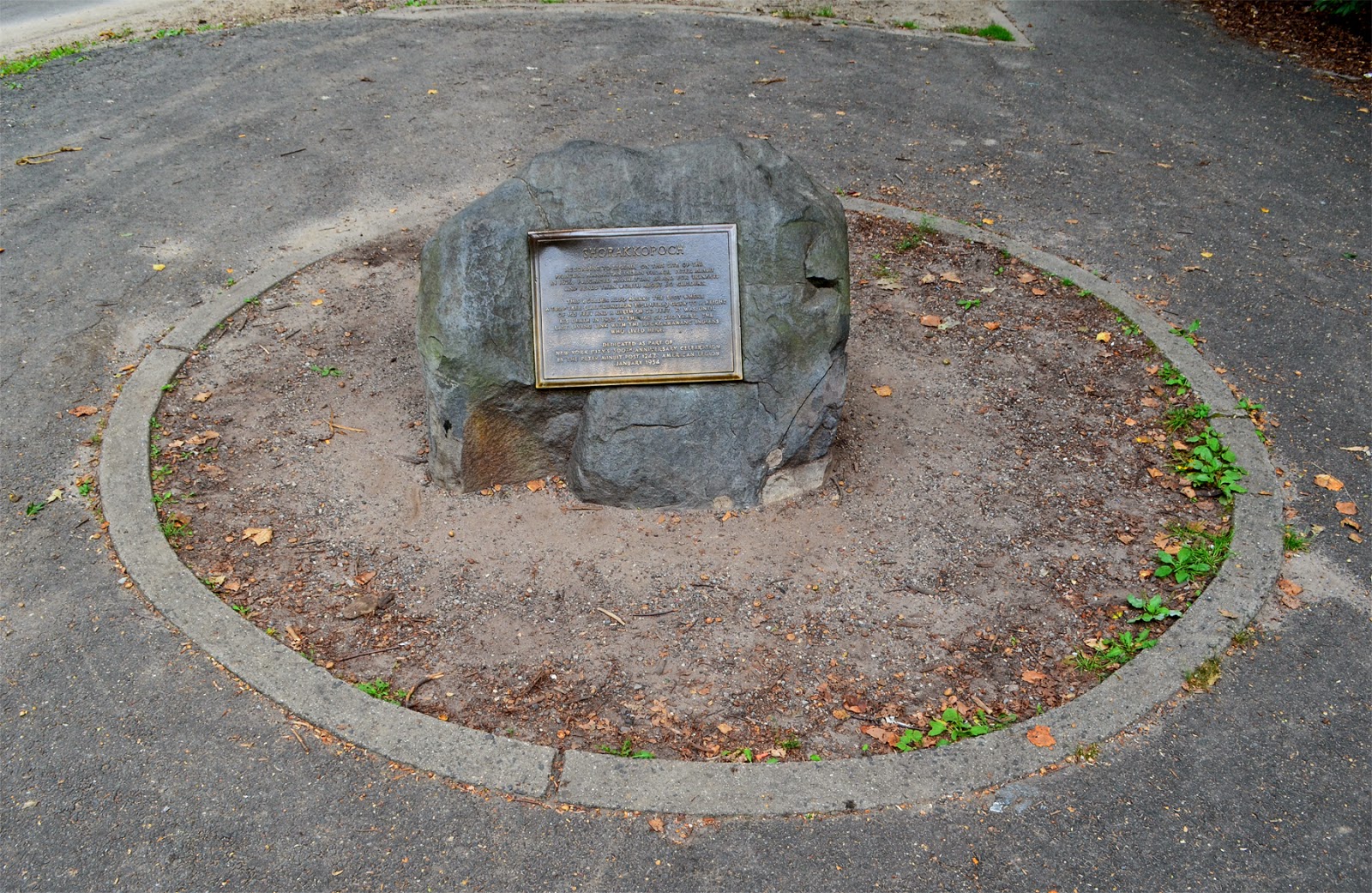
In a circular path, along the main trail - near Spuyten Duyvil Creek (Dutch for "spewing devil") - is Shorakkopoch Rock, which marks the supposed spot where Peter Minuit purchased Manhattan from the local Lenape tribe, in 1626, for ornamental jewelry worth 60 guilders.


Originally, a tulip tree symbolized the exchange at that spot, but, at 220 years old, it died in 1932. Sponsored by the American Legion, a boulder and plaque were placed there in 1954.


If you walk into the hill area, eastward, you should come across a large boulder cropping, locally known as the Native American Caves.


While it is believed the Lenape tribe did use these large spaces between the rocks as gathering spots, no one has ever settled here, but a handful of homeless now and again.


New York City's largest glacial pothole is located in the immediate area, but, sadly, I couldn't find it.
After your visit, you can walk over to the creek, and admire the view of the Henry Hudson Bridge, the Bronx, and a large C, placed along the channel by Columbia University's athletics department, as their boathouse is nearby.


When you exit from this corner of the park, you'll be near Broadway and 216th Street, where you can see the Seaman-Drake Arch.


The archway was originally over the road of, and entry to, Dr. Valentine Seaman's 1855 mansion, and is the only remaining evidence of the estate. It is now the entrance to an auto body shop.


The span was constructed using Inwood marble, which was quarried from the neighborhood, is 35' (11 m) tall, and 40' (12 m) wide. Due to weathering, most of the interior has collapsed, and is now hollow.
In 1905, the property was bought by contractor Thomas Dwyer, who then changed the name of his company to Marble Arch Company. In 1938, Dwyer sold the land to the development company which built the complexes currently behind the arch.
Even though New York City Councilman Robert Jackson tried in 2004, the arch is not in the National Register of Historic Places.

Friday, January 9, 2015

Emma Goldman's Home

Since I posted about the 1920 Wall Street bombing, I thought I'd post a short piece on another shrine to Anarchism.
It is the home of Anarchist writer and activist Emma Goldman (1869 - 1940), who lived at 208 E 13th Street, in the East Village neighborhood of Manhattan, from 1903 to 1913.


Born In Russia, she moved to Rochester, NY in 1885, then moved to New York City in 1903. While here, she wrote a few books (Anarchism and Other Essays, 1910, and The Social Significance of the Modern Drama, 1914), causing a stir locally with speeches against everyone in government.
She was deported back to Russia, in 1919, by Attorney General Alexander Mitchell Palmer, J. Edgar Hoover, and the Labor Department.
There is a plaque on the west side of the building to commemorate Goldman's stay there...


...but others of interest had lived in that location as well.


According to the plaque on the east side of the same building, there once stood a small farmhouse on this spot, where then-president of Mexico, Benito Juarez, asked his wife, Margarita Maza, to stay from 1864 - 1867, during the war of Mexico's resistance against France for sovereignty, after Spain left in 1821.