Monday, October 26, 2015

Dead Horse Bay

Dead Horse Bay is many things to many people. It’s a small inlet beach that overlooks Rockaway Point to the south, and Point Breeze to the north. Located on Floyd Bennett Field, which was once called Barren Island, until a landfill created a connection between it, and mainland Brooklyn, in 1926. It’s a place to collect antiques, or find fossilized horse bones, and a testament to mankind’s hubris.
Folks used to live here in the mid-1800s, and from 1850 through 1930 the area got its name from the near-30 horse rendering plants that used the animal’s carcasses to manufacture glue, fertilizer and hair brushes. The addition of fish oil factories, and the odor caused most to move away.
Around the late-1920s, the city began to use the area as a landfill, dumping trash, and later covering it with beach sand from Jamaica Bay.
In 1950, the landfill burst underwater, and the rubbish has been leaking since, washing up along the shoreline.
A visit during high tide leaves one depressed enough with the sight of glass shards everywhere, but low tide can send one into a fit, as you traverse through a line, two meters thick, of full bottles, old machinery and miscellaneous waste that runs the shore of the entire peninsula.
The area hasn’t lost its reputation for garbage collecting, as a few boat owners have beached their unwanted crafts, which are later hit by visiting graffiti artists, and vandals. The trees are often decorated with beach debris, and the trails are normally a dumping ground for those who feel they carried too many superannuated bottles full of sand before heading back to their car.
Dead Horse Bay is a sight that one must see for themselves to truly get a grasp of what we are doing to our planet.
Photos do not do this unnatural injustice to nature any justice, but here you go anyhow.


Monday, October 12, 2015

Normandie Metal + Dodgers' Office + Kennedy(s) + H.P. Lovecraft

If you find yourself in Brooklyn, around Borough Hall, start this little walk at the NE corner of Remsen and Henry Streets, at the Our Lady of Lebanon Maronite Catholic Cathedral. The two doors facing both streets hold some of the last remains of the SS Normandie.


The French ocean liner entered service in 1935, having only the RMS Queen Mary as her closest rival. At that time, she was the largest and fastest passenger ship, and still holds the record as the most powerful steam turbo-electric-propelled passenger ship.
In 1940, after France fell to the Germans, the U.S. confiscated the SS Normandie, while docked in New York City's harbor. The ship became part of the United States Navy in 1941, and renamed the SS Lafayette. In February of 1942, as the liner was being refitted off a NYC pier to become a troop ship, a welding spark set off a fire, which caused the entire vessel to burn, and then capsize. The wreckage was not removed until 1946, and took two years to finish.
Not much remains of the Normandie; an entire corner is preserved at the city's Metropolitan Museum of Art, a bronze statue (found in a NJ junkyard in 1954) is in Miami's Fontainebleau Hotel, plenty of scattered crystal from the dining salon's massive Lalique torchières, some silverware, and the ten large dining-room door medallions currently displayed on the church doors.


Now, walk up Henry, and then right on Montague Street to 211 Montague, once home to the Brooklyn Dodger's offices. The 1998 plaque celebrates that it's where they signed Jackie Robinson in 1945, becoming the first African-American in the major leagues.


Look across the street, into Columbus Park, and you may lock eyes with Robert F. Kennedy. While the park has a statue to Columbus, and Henry Ward Beecher, as well as hold the Korean War Veterans' Plaza, two Kennedy memorials are here: Robert Kennedy's 1972 bust by sculptor Anneta Duveen, and - just behind it - a tree planted in 1963 by Brooklyn Borough President, Abe Stark, for John F. Kennedy.


Lastly, head south on Court Street, with a right (west) on State Street to the corner of State and Clinton to see 169 Clinton, the one-time home of horror writer Howard Phillips Lovecraft (1890 - 1937), inventor of the Cthulhu Mythos.


Lovecraft lived here in 1925, and hated the area so much he penned the short story "The Horror at Red Hook" while living there, though it wasn't published until 1927 in Weird Tales.


He wrote to his friend and fellow writer Clark Ashton Smith:

The idea that black magic exists in secret today, or that hellish antique rites still exist in obscurity, is one that I have used and shall use again. When you see my new tale "The Horror at Red Hook", you will see what use I make of the idea in connexion with the gangs of young loafers & herds of evil-looking foreigners that one sees everywhere in New York.

Woops! It's no wonder modern scholars have such a problem with HP's legacy.


Monday, September 21, 2015

Green-Wood Cemetery

Green-Wood Cemetery is one of the most beautiful, and therefore famous, in the United States. While the graveyard holds approximately 600,000 entombed, throughout 478 acres (1.9 km²), it has been used by locals as a park since its construction, and was a huge tourist attraction in the 1850s.
Located in an area of Brooklyn known as Greenwood Heights, it was founded in 1838 by social leader Henry Evelyn Pierrepont, and inspired by Cambridge, MA's Mount Auburn Cemetery.
The main entrance (at 5th Avenue and 25th Street) was built in 1861, of Belleville brownstone, and was designed by Richard Upjohn in a Gothic-revival style.


The groups of sculptures atop the gateways, which are the work of John M. Moffitt, depict biblical scenes from the New Testament, including Lazarus, the Widow's Son, and Jesus' resurrection.
Though the cemetery did not receive landmark status until 2006, the main gate had gained recognition as one by the New York Community Trust in 1958.
There are quite a number of monuments on the grounds, many of which memorialize victims of local tragedies, such as a sculpture of a ship, half-submerged by waves for the six members of the Brown family who perished in the 1854 SS Arctic disaster, or the obelisk which commemorates the 278 lives lost in what became known as the Brooklyn Theater Fire of December, 1876.


There is also the Civil War memorial, located at the summit of Battle Hill (Brooklyn's highest natural point, 200 feet above sea level)...


...as well as the Revolutionary War monument by Frederick Ruckstull, and the Altar to Liberty, which was built in August of 1920, on the 144th anniversary of the Battle of Long Island (the first battle of the American Revolution after the Declaration of Independence, and the largest battle of that war).


Next to the altar stands a bronze statue of the Roman goddess Minerva holding a wreath in her right hand, and waving "hello" to her sister, the Statue of Liberty, with her left. For good fortune, many visitors leave coins on the altar, within the bronze wreath she holds.


It goes without saying that there are quite a number of beautiful grave markers in Green-Wood.


Many of which belong to those who departed in fame, while others in infamy.

Composer, Leonard Bernstein (1918 - 1990)

Painter and code inventor, Samuel Morse (1791 - 1872)

Artist and musician, Jean-Michel Basquiat (1960 - 1988)

U.S. Senator, and NY Governor, DeWitt Clinton (1769 - 1828)

Pianist, Albert Ross Parsons (1847 - 1933)

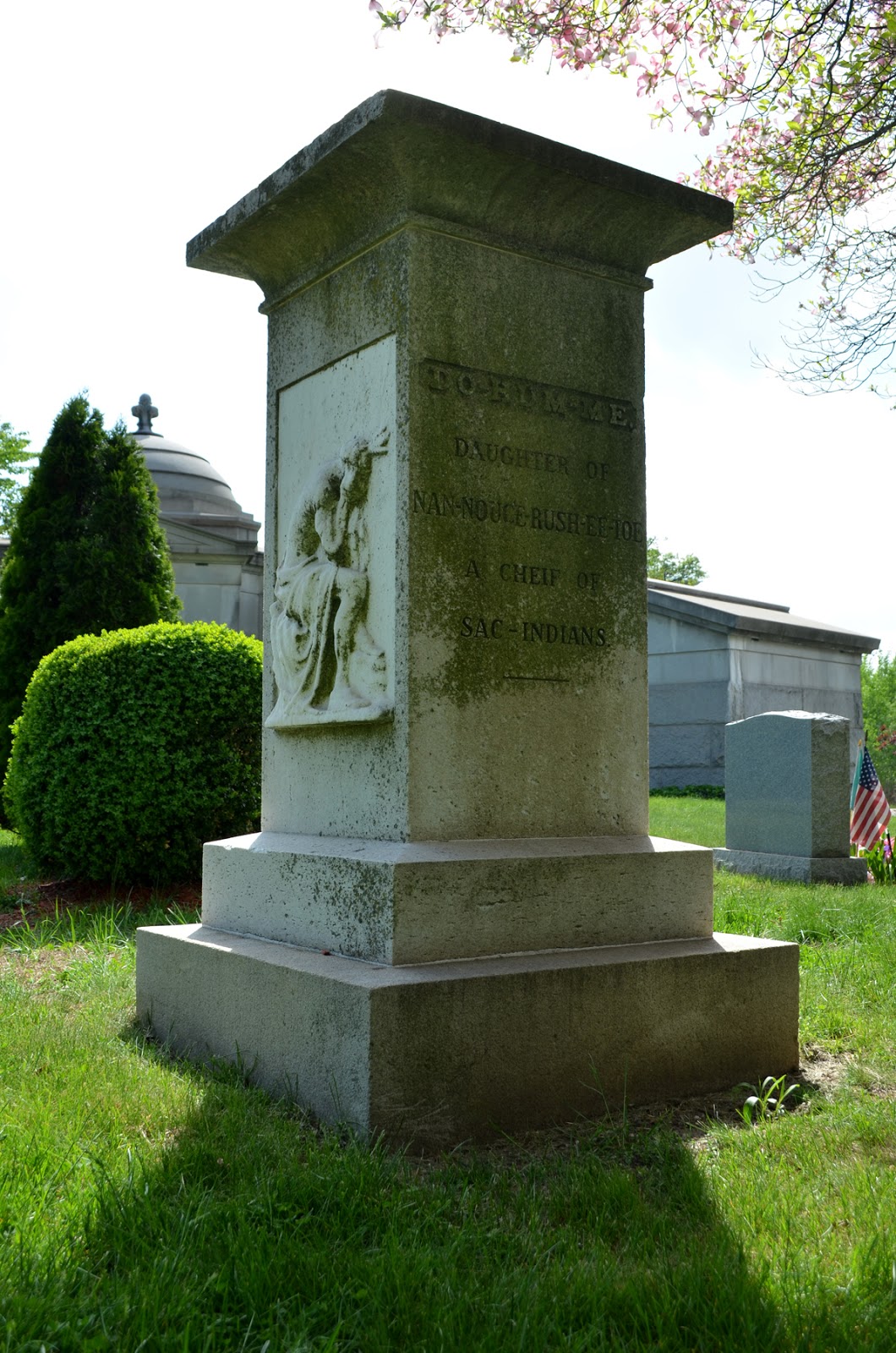
Sac Native American "Princess", Do-Hum-Me (1824 - 1843)

Soda inventor, John Matthews (1808 - 1870)

Gangster, William "the Butcher" Poole (1821 - 1855)

Founder of the American mafia, Umberto Anastasio [aka  Albert Anastasia] (1902 - 1957)

And while there are no dogs allowed to be buried in any U.S. cemetery, it won't stop those who can afford it to compliment their beloved pets.


The property is huge, and it may take a full day (or even two) to walk to many of the sites I've written about, but don't leave without seeing the cemetery's chapel, which was constructed in 1911 (and restored in 2001).


Designed by the architectural firm of Warren and Wetmore (who also designed Grand Central Terminal), the small church is a replica of Christopher Wren's Thomas Tower at Christ Church College in Oxford, England.


In 2012, Hurricane Sandy toppled almost 300 trees in the cemetery, and the damage was estimated at half a million dollars, but the non-profit institution Green-Wood Historic Fund (created in 1999) continues to preserve this wonderful Brooklyn landmark for the public.

Thursday, September 10, 2015

Pomander Walk + Shinran Statue

If you find yourself looking for something to see on the Upper West Side, here are three sites worth visiting.
First is Pomander Walk, centered between 94/95th Streets, plus Broadway and West End. This 27-unit apartment complex was built in 1921, in miniature of Queen Anne mansions, and named after the 1910 Louis Parker romantic comedy of the same title.


Very different from what surrounds the area, this slice of Manhattan was supposed to be a standard high-rise hotel, but when nightclub owner Thomas J. Healy couldn't get the permits, he decided to build these quaint homes designed by the New York architecture firm King and Campbell. They were to house a handful of the rich, until he could set up his grand inn.


Luckily for us, Healy never could get that charter, so we can see today what former-resident and novelist Darryl Pinckney called "an insertion of incredible whimsy" into New York City.
While you do have to be a resident to enter the grounds, one can view much of Pomander Walk via either gate, on 94th or 95th Street.
Though landmark status was rejected in 1966, Pomander Walk was finally registered in 1982 when tenants formed a committee to block further development.
Up next, and only a few blocks away is what many call the "Atomic Buddha", the Shinran statue.


Found out front of the New York Buddhist Church, at 332 Riverside Drive, the 15ft (4.5m) bronze statue of Buddhist monk Shinran Shonin (founder of the Jodo Shinshu school of Buddhism, 1173 - 1263) once stood at a temple in Hiroshima, Japan.
Only a mile-and-a-half (2.5km) from the August 6th blast zone, this beautiful piece of sculptured metal was one of the few things left standing after detonation of the atomic bomb.


In September of 1955, an anonymous Japanese businessman had the Buddhist society ship the statue to New York City as a symbol of lasting world peace. It has stood there since, with the addition of a marble plaque, with full story, added in May of 1985.
Last stop is about a mile north, and, admittedly, only for fans of that tv show about nothing, Seinfeld: Tom's Restaurant.


While called Monk's Café on the show, the exterior (located at 2880 Broadway) was used as a stand-in for the fictional cafeteria on Jerry Seinfeld's sitcom. The interior looks nothing like that on the show, but for true fans, it's a cool sight to see just from the outside.
The restaurant has been owned and operated by the same Greek family since it opened in the 1940s. Before Seinfeld, the restaurant had already inspired Suzanne Vega's 1981 song "Tom's Diner", and was Senator John McCain's favorite place to grab a bite when he visited his daughter at Columbia University.