Friday, August 21, 2015

Split Rock

Up until the Age of Enlightenment, women played only a very small role in driving doctrine. Though many outspoken prophets are still male, our modern outlook on the metaphysical has been molded by feminine hands, such as Theosophy founder Helena Blavatsky, and Mary Baker Eddy, who began Christian Science. While men dominated theological literature before the 1900s, a women’s vision rivaled any male seer’s in the early 20th Century.
Definitely, and without knowing it, the godmother of this movement is Anne Hutchinson, then known as the “American Jezebel”.
Said to be related to Charlemagne, Alfred the Great, and Edward I of England, she was the daughter of an Anglican minister in London; born in 1591, in Alford, England, and only making her way to New England at 43, coming after her pastor in 1634. She docked on the harbors of Boston with her husband, and ten children, in tow, but don’t think lowly thoughts, as William Hutchinson was a wealthy mercantile businessman.
At the time, she was a student of Puritan minister John Cotton, who preached Free Grace theology, which believed anyone to be free from sin, receiving eternal life, once they accepted Christ as their personal savior. While many believe that to be the standard tenant of Christianity, it brings up the problem of grace earned, over inherited.
John Cotton felt, because of his religious views, to be persecuted by the Church of England, and "impressed by the evidence of divine providence" in the Americas, hit the sails to what many considered the New Jerusalem.
When he left England, she followed.
After the move, Mr. Hutchinson did well, and bought property, building one of the largest homes on the Shawmut Peninsula. It stood there until the Great Fire of 1711, which destroyed much of what is currently downtown Boston.
Most in the area began to know Mrs. Hutchinson as an available midwife, who also taught in spiritual manners, and moral matters, through a Bible studies class. In her home studies, she would often point out that good works would not get you into Heaven, and only "an intuition of the Spirit" would open the Pearly Gates. She would often remark on how God has no mind on what we do in the here and now, so long as we accept his salvation.
Word got back to the church elders, and all unauthorized classes were ceased, which began the Antinomian Controversy.
In 1635, at Jon Cotton’s home, several ministers confronted Cotton and Hutchinson concerning their “free grace” views. Though the two thought they left the meeting walking on common ground, Hutchinson, and a handful of supporters were dragged into court for heresy.
When writing of this time, in his 1651 book, Of Plymouth Plantation, Plymouth governor, and a scrivener on the Mayflower Compact, William Bradford, claimed that many in the area had returned to paganism, witnessing characters dance around the maypole, inviting the Natives to join them, as if they had revived “the beastly practice of the mad Bacchinalians.” He condemned the debauchery of “drunkenness and uncleanness; not only incontinency between persons unmarried, but some married persons; acts fearful to name, such as sodomy and buggery, have broke forth across this land.”
Even her mentor, John Cotton, once wrote Hutchinson's meetings were a “promiscuous and filthy coming together of men and women.”
While her prosecutors focused on theological issues, many are certain these attacks were in part due to the fear of a woman’s role in church affairs; she had failed to learn her place in Puritan society.
Already excommunicating and banishing other “free grace” preachers of the church, such as Reverend John Wheelwright, the General Boston Court set way to exile Anne.
Hutchinson, labeled “an instrument of the devil”, was found guilty in 1637. After a winter house-arrest, and with no supporters left locally, besides her immediate family, she was brought before a church court, as the previous trial was only a civil matter. In the earlier trial, they dug into what she had been doing to society, now they were going to look at what she had done to religion.
Of course, the Puritan Church handed her a guilty verdict, and she was now branded with the title of heretic, too.  She was given three months to pack her bags, and get out of town.
Many of those who had heard the good word, and knew trouble was coming, migrated to what is now Providence, Rhode Island. When Hutchinson was released, she was accepted there with open arms, but not before a six-day walk - with her kids, and in April snow - from the Boston area. Sadly, her reputation followed, and the local magistrates started getting nervous as to what trouble she could start there, as she mingled with people of power. The family moved to Portsmouth, were her husband died in 1639, and, in 1642, her and six children moved south to New Netherland.
The following year, during Kieft's War, where the Encyclopedia Britannica wrote as “an event regarded by some in Massachusetts as divine judgment,” Anne (and most of her children) were killed by Siwanoy tribe members, in what later became the Bronx borough of New York City.
Today, Hutchinson is remembered much differently than she was, as the engraving on her bronze statue in front of the Massachusetts State House reads it was placed there for her work as a “courageous exponent of civil liberty and religious toleration.”
In a Harvard Magazine article on Hutchinson, Harvard Divinity School theologian, Peter Gomes, called her “deft in theological and legal sparring, intellectually superior to her accusers, and a woman of conscience that yielded to no authority,” and going on to say she would be more at home in the Harvard of today than any of her critics.
She was also immortalized in the first chapter of Nathaniel Hawthorne’s The Scarlet Letter (1850), as “the sainted Anne Hutchinson,” as was her struggle in the 1980 play Goodly Creatures by William Gibson, and, more recently, in Dan Shore's opera, Anne Hutchinson.
The spot in the Bronx, where she was supposedly to have died is marked by a huge broken boulder, called Split Rock.
In the 1950s, New York City officials were persuaded by Dr. Theodore Kazimiroff, head of the Bronx Historical Society, to move the planned building of I-95 just a tad north, so as to save that sacred spot from being blown to bits by construction dynamiting, and now Split Rock is located on a triangular piece of land in between I-95, the Hutchinson River Parkway, and the northbound Parkway ramp leading to northbound I-95.


There are two ways to visit: one legal, the other, not so much.
One can use the pedestrian trail that begins on Eastchester Place - crossing under I-95, following the trail beside the northbound lanes of 95, and then rising to share the overpass (crossing over the Hutchinson River Parkway), and ending at the boulder.
The other way is a little more exciting, and - even though you can see a lot of local wildlife - is discouraged.


Parking at Split Rock Golf Course, you head to the west end of the course (under the railroad overpass), and follow the horse bridle trail northward. About 1 mile in (1.6 km), you will notice the northward fence of the golf range meets a westward fence. That chain-linked fence corner points to Split Rock, but you’ll have to illegally cross the entrance ramp to I-95 to get there.


Split Rock is an elongated, dome-shaped granite boulder, about 25 feet (7.6 m) long, by 15 feet (4.6 m) wide. The rock was moved here from Canada possibly around 15,000 years ago, and cracked around 10,000 due to heat stress.


A bronze plaque, which is now gone, was placed there in 1911, reading:

ANNE HUTCHINSON 
Banished from the Massachusetts Bay Colony in 1638, because of her Devotion to Religious Liberty. This Courageous Woman sought Freedom from persecution in New Netherland. Near this Rock in 1643 She and her Household were Massacred by Indians. This Tablet is placed here by the Colonial Dames of the State of New York. 
ANNO DOMINI MCMXI Virtutes Majorurn Filiae Conservant


Though the plaque has been removed due to vandalism, the rock, pushed there thousands of years ago, will probably stay there, split as it is, forever - dual and eternal - like Anne’s legacy.


If you’ve headed there by car, and are still in the mood to see large rocks, check out Glover’s Rock on Orchard Beach Road, just before it meets Park Drive.


A rare white-granite glacial boulder, it is the spot where, during the American Revolutionary War Battle of Pell's Point, Colonel John Glover reputedly stood to watch the British forces. On October 18, 1776, he and 600 patriots held off advancing troops, so General George Washington could regroup, and lead his troops to victory.

Monday, August 10, 2015

Tompkins Square Park Oddities

Unlike Bryant Park, or Washington Square Park, the locals have always used the lot known as Tompkins Square as a public meeting place. It was previously just a small section of Stuyvesant Meadows' salt marsh, until 1829 when it was accepted by Manhattan as a gift from Peter Gerard Stuyvesant (1778 - 1847) for a tax break, with the agreement that the land would always be used as a park open to all.
Tompkins Square (named after U.S. Vice President under President James Monroe, Daniel D. Tompkins [1774–1825]) was established in 1834, and its cast-iron fence was added the following year. Thought to be set in an ideal part of the city that would boom, the Panic of 1837 brought the city's expansion to an end, and the area was considered a haven for immigrant communities by some, and a slum by others.


The public square was later deemed a park, reopened in 1850, and it soon became the local meeting ground for those unhappy with the trappings of the Industrial Age.
In 1857, police attacked the locals in the park protesting unemployment and food shortages. In July of 1863, laws passed by Congress to draft men into the ongoing American Civil War, sparked the Draft Riots within the park. In January, 1874, the Tompkins Square Riot occurred, then, in 1877, 5,000 people fought the National Guard as they attempted to listen to Communist speeches.
In short, the area is a historical hotbed for political activism, but it also holds some interesting curiosities you might want to see, besides the crust punks, and chess wizards.
While the park contains a handful of monuments, the one with the most tragic background would have to be the tribute to the General Slocum boating disaster of 1904.


A few locals, and even some visitors, have asked, "If there is a Little You-Name-It, why no Little Germany?" There was, Kleindeutschland, until June of 1904, when 1342 of Little Germany's residents (including the entire congregation of St. Mark's Evangelical Lutheran Church) were crossing the east river to an annual picnic. The steamship they were on, the PS General Slocum, caught fire, and sank off North Brother Island, near the Bronx shore, killing 1021.
While there is a monument of statues over the mass grave of the victims, the Sympathy Society of German Ladies asked to also set one up in the neighborhood that lost so many of its citizens. The pink Tennessee marble stele was erected in the north side of the park in 1906.
On a lighter note, Tompkins Square Park's Dog Run was the first in New York City, and many think in the country. Opening in 1990, it has been a place for tourists, and locals alike, to take a moment and smile.
Sometime in the mid-90s, a tree in the center of the run fell over, and a local chainsaw artist created a bone-shaped plaque, which many began to add the dog tags of little ones who had passed. The original "bone memorial" had weathered into bits, but a new, double-sided one replaced it during park renovations in 2008. You can still add your pet's old tags, or - as most do now - purchase memorial plates.


Be sure to drop by in October, as the park holds the Annual Tompkins Square Halloween Dog Parade, known as the biggest dog Halloween party in the U.S., with an attendance of over 400 dogs in costume.
Lastly, there are many awesome trees in Tompkins Square, but none are as "blessed" as the American Elm (Ulmus americana) in the near center of the park.


Known as "the Hare Krishna Tree", it is at the base of its trunk, where, on October 9, 1966, A.C. Bhaktivedanta Swami Prabhupada (1896 - 1977), founded the International Society for Krishna Consciousness, with the first chanting session of the Hare Krishna mantra outside of India (creepy pedophile, but great Beat poet Allen Ginsberg was present to document the event).
If you enjoy just walking around and looking up in trees, you'll be in for a treat, as the park has a small population of red-tailed hawks (last numbered at two juveniles, and an adult male).


Please don't disturb or taunt the birds if you see them, as they are already so used to humans, they will often swoop right by park-goers to catch a mouse nearby.


If you aren't in the area for the October dog fun, the spring and summer here are also wild times, as there are punk, and art, shows within the park, such as this past weekend's 27th Annual Tompkins Square Park Riot Punk Show. Two days of punk bands shouting bad words at the Boys In Blue for their 1988 trespass against the park's homeless.

Nihilistics, August 09, 2015

The Deceivers, August 09, 2015

The Blame, August 08, 2015

Simon and the Bar Sinisters, August 08, 2015

If you can't find the secret spot in the park where Daniel Rakowitz once set up a food stand in 1989, and fed the homeless the remains of poor Monika Beerle, but are still up for hanging around the area to find more weirdness, take a walk west down St. Marks Place.
You'll come across 96 - 98 St Marks Place, which are the two tenement buildings used by Peter Corriston for the cover of Led Zeppelin's 1975 LP, Physical Graffiti.


Further down the street is a speakeasy-turned-theater, Theater 80, at 80 St Marks Place.
Opening in 1960, owner Howard Otway refurbished the house and hall in 1971, and had Hollywood stars come out to the opening party, so they could leave their prints in the cement just outside.
Some of the originals on the sidewalk include Joan Crawford, Kitty Carlisle, and Gloria Swanson, with the addition of Dom DeLuise in 1983...


...and Joan Rivers in 2011.


Thursday, July 23, 2015

West Village Weird (Part Two)

As I mentioned in Part One, I'm breaking down This Hidden City's visit to the West Village into two circled walks, with this post as the second circular walk, this time on the east side of the West Village.
With this entry, I'll begin at the northeast corner of W. Houston Street and LaGuardia Place, where there is a large lot (25' x 40' / 7.6 x 12m), which was turned into, what artist Alan Sonfist calls, "land artwork". Titled Time Landscape, the garden plot consists only of plants which are native to the island, and is meant to give New Yorkers a view of what the area looked like before the Colonists' arrival.


First proposed in 1968 by Sonfist, with the essay "Natural Phenomena as Public Monuments", the project was publicly unveiled in 1978. As you walk north along LaGuardia Pl, you can spot birch trees, beaked hazelnut shrubs, red cedar, black cherry, witch hazel, mugwort, Virginia creeper, aster, pokeweed, milkweed, oak trees, white ash, American elm trees, sassafras, sweetgum, tulip trees, arrowwood, dogwood shrubs, bindweed, catbrier vines, and violets - all planted by the artist.
When you approach Bleecker Street, begin walking westward, and you will come to the corner where Bleecker crosses 6th Street, Downing Street, and Minetta Street. Turn right on Minetta St to experience the complete opposite of Time Landscape, as this street runs over what once was Minetta Creek, a stream that was one of the largest natural waterways in Manhattan, only to be covered up.


The name is derived from what the local Native American's called it, Manette, which translates as "devil's water". Some say the creek still runs under the streets of Manhattan, while others claim the construction completely stopped its flow.
At the end of Minetta Street, make a right, and you'll almost immediately find yourself in front of one of the most happening spots in Beat and Hippie history: Cafe Wha?.


Opening in 1959, and closing sometime in the mid-60s, the joint was bought by club manager, and uncle to David Lee Roth, Manny Roth. It became a popular hangout for comedians, musicians and hipsters, such as Bob Dylan, Jimi Hendrix, Bruce Springsteen, The Velvet Underground, Woody Allen, Lenny Bruce, Bill Cosby, and Richard Pryor.
Roth sold the place in 1968 to Menachem Dworman, who ran it as Cafe Feenjon, changing the style from Beat poetry, and rock-n-roll, to falafels, and Middle Eastern music, until 1987, when Dworman's son Noam changed it back to its original name, and brought back the rock.
Head back to Bleecker St, and walk east to Wooster Street, where you'll find the Silver Towers Complex. Within their courtyard stands a huge (67 ton), two-sided, concrete sculpture of Picasso's 1954 "Bust of Sylvette" (originally inspired by beautiful 19-year-old Sylvette David).


While many think this 1968 installation is by Picasso himself, the truth is he didn't have much to do with it. It turns out that Picasso doesn't have any outdoor sculpture in the U.S., besides his 50' (15m) / 140 ton piece in Chicago. The work is actually by Norwegian sculptor Carl Nesjar, who only asked Picasso (by mail) if he could recreate it.


The most Picasso has to do with this work is that he created the small, metal original, and replied with a "yes" to Nesjar. Sadly, the plaque almost hides this fact, by placing Picasso's name larger than Nesjar's.


Speaking of phony, walk over to 85 W 3rd Street to see Edgar Allen Poe's home (from 1844 to 1846), where he was said to finish "The Raven".


Why did I write "phony"? Because this isn't his home, nor ever was.
Poe lived in the immediate area, but his house was demolished by NYU to make room for Furman Hall. Only the facade was somewhat preserved, as well as moved a block away to where it is now.


Walking east again, we come to NYU's Schwartz Plaza, which keeps their Founder's Memorial.


The top of the landmark holds the only remaining piece of the original Gothic Revival-styled building of New York University's first campus, which was built in 1835. When it was demolished in 1894, the school decided to keep the spire at its Bronx dorms. When those buildings were sold in the 1970s, the peak of the original was moved to where it is today.


Now, as if floating along Minetta Creek, cut through Washington Square Park - all the while keeping in mind that the park was once New York City's largest pauper's grave - and cross over to 2 W 5th Avenue, and you can see a plaque on the exterior of the building where Minetta Brook once poured forth.


The plaque reads:

A brook winds its erratic way beneath this site.
The Indians called it Manette or Devil's Water To the Dutch settlers it was Bestevaer's Killetje or
Grandfather's Little Creek For the past two centuries familiar to this neighborhood as Minetta Brook.

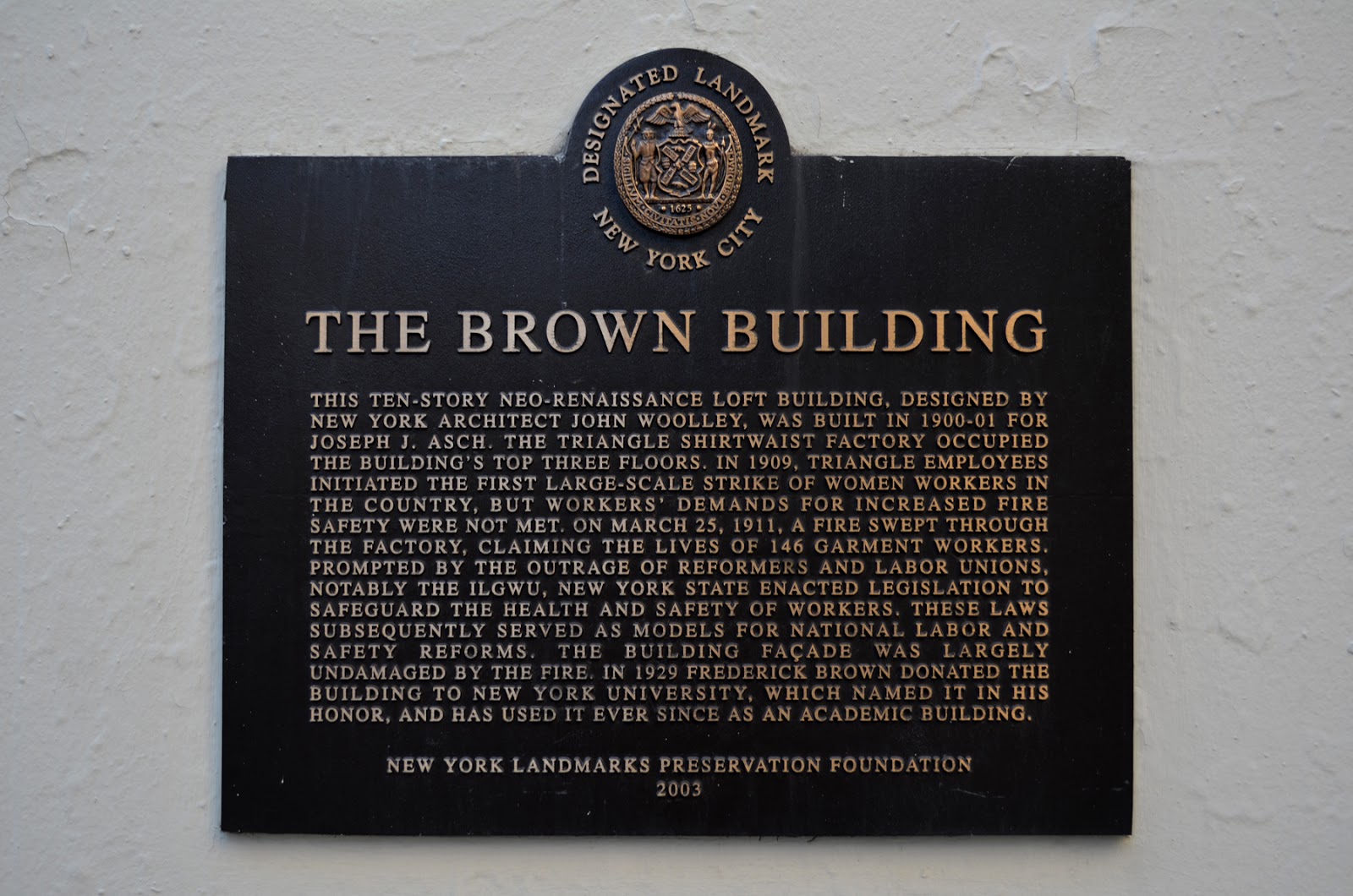
The last stop on this trek is just a hair outside the West Village, but sits just east of Washington Square Park, so I thought to include it. It is 23-29 Washington Place (between Greene Street and Washington Square East), known as the Brown Building.


Built in 1900, it was originally named the Asch Building, after its owner, Joseph J. Aschonce.
The building's top floors were once occupied by the Triangle Shirtwaist Factory, and it is the site of a terrible fire, which killed 146 garment workers on March 25, 1911.
In case you think me a little morbid in pointing this out, New York's Landmarks Preservation Foundation marks the spot with a plaque on the southeast corner.


While this walk ends on a sad note, do know that the deaths were not in vain, as the fire led to legislation improving safety standards for workers, and helped spawn the International Ladies' Garment Workers' Union.
The location was entered into the National Register of Historic Places in 1991, and was designated a New York City landmark in 2003.

Monday, July 13, 2015

West Village Weird (Part One)

As with my posts on the Hudson River (of that, see part one here, and two here), I'll be partitioning this entry in two. Seeing that the West Village has quite a number of interesting spots, I'll break it down into walking in two circles, with this as the first circular walk on the west side of the West Village.
We begin at 56 7th Ave S, with one of the few advertisements for a business you'll ever find on this site: Greenwich Locksmiths, and their wonderfully wild facade.


Opening in 1968, the building stayed much the same, until in 2008 when owner, Phil Mortillaro, had the idea to cover the front - using 50,000+ keys - to portray his version of Starry Night by Vincent Van Gogh. It took him until 2010 to complete the work.


Walk a little south, and then make a right to go up Bedford Street for some post-Colonial American history.
On the corner of Commerce Street and Bedford is 77 Bedford, which is the oldest house in the area.
Built by copper magnates, and known as the Isaacs-Hendricks House, it was constructed in 1799, using wood, but later converted to brick in 1836.
Next door to it, at 75½ Bedford is the thinnest house in all of New York City, with an exterior width of 9 feet (2.7 meters), and an interior of 8 ft (2.4m). Built in 1873 as a cobbler's shop, the small plot of land was then converted into a candy factory in 1880, when candy heiress Martha Banta bought the property. It later passed from owner to owner, but its size made it an interesting entry into the New York Historical Society newsletter, complete with a photo, in 1922.
Sadly, I couldn't take a decent picture of either (except for the door at 75½), due to both being under construction.


As you walk north on Bedford Street, always look up at the corners of buildings. There, one can usually spot markers with a bit of history about the area.


Still on Bedford, one will soon approach 17 Grove Street, in which stands the oldest wood home in Manhattan.


Constructed in 1822, the building was two-stories tall, until 1870, when a third floor was added. The house was originally owned by sash-maker William F. Hyde, but the public can take a look inside every year, when the Greenwich Village Historical Society does its annual "house tour".
Keep walking north, and then make a left, onto Christopher Street, to check out Weehawken Street: Manhattan's shortest block.


The street used to have an amazing set of "no urinating" signs, that were often photographed by visitors, but have since been removed. You can see a classic one online here.
Now, walk two blocks north, and back east a bit, to 121 Charles Street, where an anomaly stands.
No one is certain when it was first built, though tax records do show the home appearing on maps in 1898. What makes this so strange is that the farmhouse, which sits on this small triangular-shaped lot, wasn't even here until 1967.


The building originally stood at 71st Street, and York Avenue, and, in the 1940s, was owned by author of Good Night Moon, Margaret Wise Brown.


In the 60s, the Roman Catholic Archdiocese of New York bought the land, and the house was scheduled to be demolished, so as to build an old-age home.


On March 5th, 1967, with the help of architect William C. Shopsin, and at a cost of $6500, Swedish-born Sven Bernhard, who lived at there at the time, had the structure - in its entirety - moved to where it is today.
Now, the last spot visited on this roundabout isn't weird, so much as it is historically significant, and quite interesting.
On  June 28, 1969, the patrons of the Stonewall Inn, were tired of the police harassment, and constant arrests, simply for their sexuality, and rioted against their mistreatment.


This one act opened the door for, what was then called, the Gay Liberation Movement in the United States. The Stonewall Inn was originally opened in 1967 (at 51-53 Christopher Street), and was then the largest gay establishment in the U.S. Closed soon after the riots, the spot reopened as a shoe store, a bagel shop, and later a Chinese restaurant. In 1990, the bar reestablished itself (at 53 Christopher), and was entered as a National Historic Landmark in 2000.

Monday, June 29, 2015

A Walk Through Bed-Stuy

If you find yourself near where I live, Brooklyn's Bed-Stuy neighborhood, this is a tour of the interesting things in the area, that is so short (2.5m / 4k), it will only take about an hour of your time.
We begin at the enclave of Weeksville in Crown Heights. The village was founded a little after its namesake, freed Virginian slave James Weeks, bought a plot of land in central Brooklyn's Ninth Ward from another free African-American, Henry C. Thompson, in 1838 (eleven years after New York abolished slavery). At the time, black businessmen and investors purchased land in the surrounding borough's then-called Bedford Hills area, creating  one of the nations first freemen villages, with more than 500 residents by 1850.


On Buffalo Ave, between Bergen St and St Marks Ave, you can take tours of some of the original homes at the Weeksville Heritage Center (every Wed & Fri @ 3pm - click here for more info), and that includes seeing the Hunterfly Road House, which was built around 1840.


Heading west, we zigzag through Bed-Stuy to see the "Queen of Hancock Street", the Moran Victorian Mansion, at 247 Hancock Street.


This huge home was constructed for water-meter magnate, John C. Kelley, in 1887, by the then-still-very-young Montrose W. Morris, who modeled the home after Vanderbilt's Fifth Ave estate.


When headed to the next stop, you can see two other Morris-developed beauties - Renaissance Apartments (on corner of Hancock), and The Alhambra (two blocks south on the corner of Macon St) - on Nostrand Avenue. Of course, Morris' creations make up only a small part of the 577 buildings landmarked within the Stuyvesant Heights Historic District.
Before the last stop, two blocks west of Nostrand, we have the infamous mural of Ol' Dirty Bastard's 1995 debut LP, on the corner of Franklin and Putnam Aves.


It was first painted by Vic Goldfeld (see original here) in 2006 for a documentary, but later repainted by Ibrahim Yaqut in 2010. The owners of the storefront holding the work claim visitors as far as France have come just to photograph the scene.
This trip ends in the Clinton Hill neighborhood, on the corner of Gates and Grand Aves, at The Vendome.


Built in 1887, by a currently-unknown architect, 363 Grand Avenue is Brooklyn's first multi-family apartment building.


The six-story structure was seized in 1982 over taxes, after it sat in disrepair since a fire left it a mere shell in 1980. It was to be demolished in 1987, but many in the area fought to save The Vendome from destruction.


It was finally given a grant the following year by the Office of Parks, Recreation and Historic Preservation to repair and restore the 24-unit home.