Monday, June 23, 2014

A Piece of the Berlin Wall

Manhattan is a place to find all things, so why not a piece of the Cold War?
This permanent, outdoor installation is five large sections of the Berlin Wall, tucked near a trendy and expensive eatery in Midtown Manhattan.


Though addressed to 520 Madison Avenue, this relic of Capitalism-vs-Communism is actually located in the courtyard of the Continental Illinois Building, which is on 53rd Street, between Madison and 5th Ave.


The West face of the wall (which now faces east) holds the work of German artists Thierry Noir and Kiddy Citny, while the East face is blank.
This section of the Wall was moved here in 1990, when it was sold by the former DMP to Jerry Speyer of Tishman Speyer, the real estate developer who owns the building.


There are other pieces of the Berlin Wall in NYC, and they are located in the gardens of the United Nations headquarters, another at the marina of the World Financial Center, and a third at Ripley's Believe It or Not! Museum in Times Square, though I believe this one is the largest.


Monday, June 2, 2014

Cleopatra's Needle

I recently learned that if you draw a line from the Washington Monument in D.C. to a specific obelisk in London, the line cuts right through Central Park - almost corner to corner. Strangely enough, London’s sister obelisk is also in Central Park (though a bit north of said line), and is called Cleopatra’s Needle.
Immediately after finding out about this, I had to visit - dragging along my camera.
Quick history: In 1450 BCE two 71-foot, 244-ton granite obelisks were commissioned for Heliopolis, Egypt. They were later moved to Alexandria in 18 BCE. One companion was moved to London in 1878, and the other - three years later - to Central Park, NY. It is the oldest, man-made object, outdoors in NYC, and though called Cleopatra’s Needle, has nothing to do with her, besides being Egyptian.
These are the photos I took on my walk over.


The obelisk is balanced on bronze crabs. The history of the obelisk is etched on all the crabs’ claws, in several languages.


This is the south side of the obelisk, and translated it tells us of Horus, the hawk-headed child of Isis and Osiris.


In other words, it’s a big penis, used to remind you of sex and death.
So, try to get a lot of one, and none of the other.

Monday, April 28, 2014

Bennett Park

Not sure how I stumbled across this one, but it was back on a visit to enjoy the Washington Heights area to see Mother Cabrini's mummy (see entry for Feb 3, 2014).
About 10 short blocks south of The Cloisters, right across the street from the the 181 Street subway stop's 183rd St exit is Bennett Park.


Named after James Gordon Bennett, Sr. who launched The New York Herald in 1835, the park opened in 1929. Bennett Park is a part of Fort Washington, which was part of the Continental Army's stand against the British during our independence.


The park sometimes holds Revolutionary War reenactments, but what the spot is most known for to locals, is being the highest natural point in Manhattan at 265 ft above sea level.


While admittedly not even the height of skyscrapers New Yorker's are used to, it isn't even the highest point in the entire city, which is actually Staten Island's Todt Hill at 390 feet above the waters.


Still, it was such a nice area to visit, and on such a perfect day...


I decided to cross the George Washington Bridge over into New Jersey, just to say, "Hi!"

Monday, April 7, 2014

Flushing Meadows - Corona Park

I was thinking of areas I’ve been wanting to see, but have yet to visit, and the old World’s Fairground in Queens came to mind.
The park area, now called Flushing Meadows - Corona Park, contains a national tennis center, and venue for the U.S. Open tennis tournament, the home of the New York Mets baseball team (Citi Field), New York Hall of Science, Queens Museum of Art, Queens Theatre, Queens Wildlife Center, and the remains of the New York State Pavilion. Until demolished, Shea Stadium was also located in Flushing Meadows.
I, of course, went to see the old pavilions from the 1964 World’s Fair.


The pavilion was designed by modernist architect Philip Johnson in 1960, and work began in 1962. It was finished in time for the ‘64 World’s fair, and parts still remain in use, though much is abandoned. The pavilion was finally listed on the National Register of Historic Places in 2009.


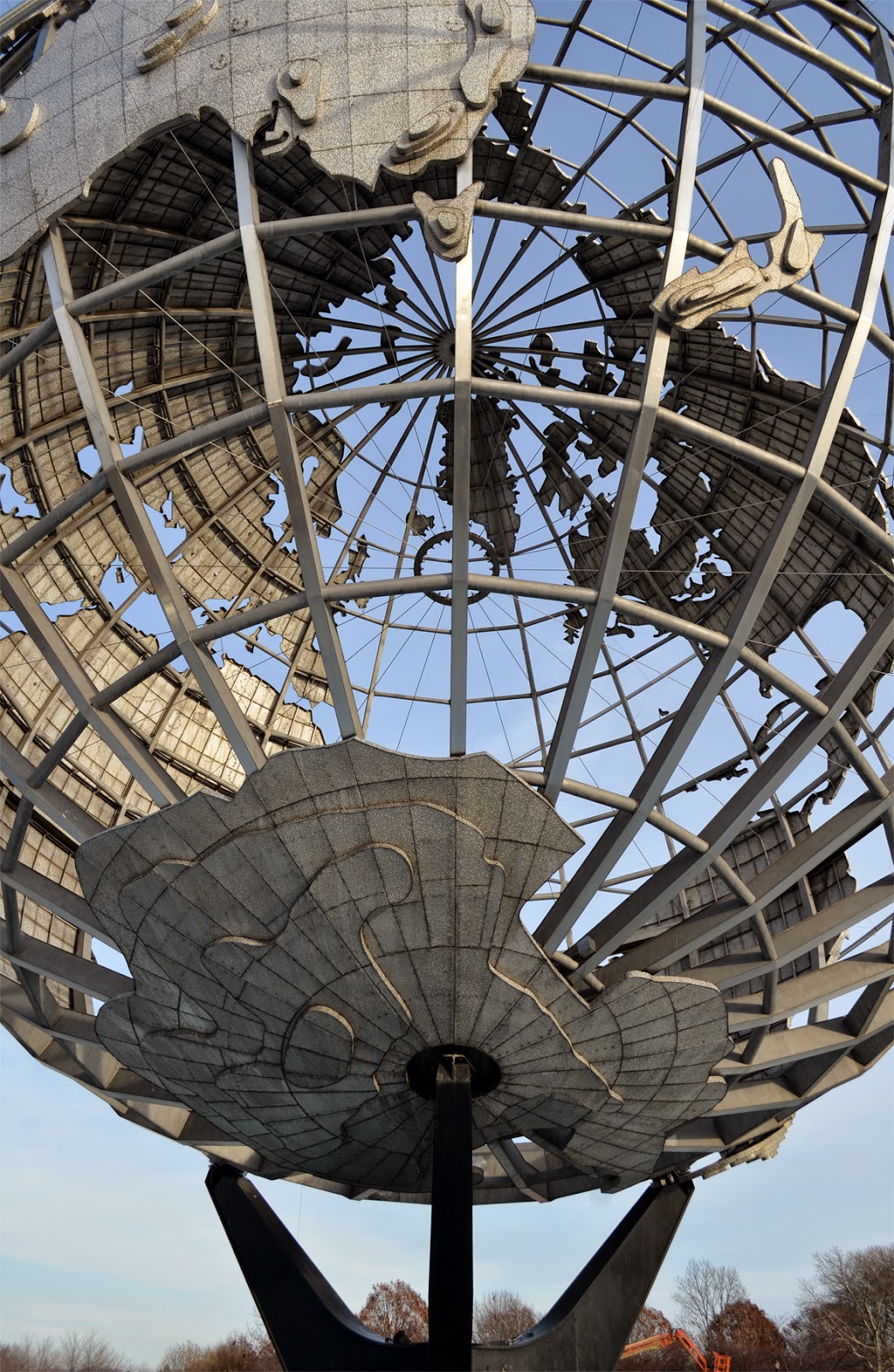
After walking the remains of NY State Pavilion, I headed to the rear of the Queens Museum to shoot the Unisphere, a 12-story, stainless steel model of our planet.


Designed by landscape architect Gilmore D. Clarke, it was to represent “man’s achievements on a shrinking globe in an expanding Universe”.


Afterward, I walked much of the park, and stumbled upon this beautiful Roman column, given to the park as a gift in 1964 by King Hussein of Jordan, which is dated from 120 CE.


I did not traverse the entire park, so I missed works and sculptures by Jose De Rivera, Donald De Lue, Eric Fischl and others, not to mention I did not come across the infamous Fountain of the Planet of the Apes.
This way, I have a reason to return.

Wednesday, March 5, 2014

Queens Giant

In the northeast area of Queens, there grows the oldest living thing in New York City, called the Queens (aka Alley Pond) Giant.


This Tulip Poplar (Liriodendron tulipifera) is also NYC's tallest tree.


Dated between 350 to 450 years old, it measures about the size of the Statue of Liberty (134 feet).


It is located in an odd spot near I-495, which is the property of Alley Pond Park, though not directly connected to it.


The exact location is difficult to come across.


Rightfully so, as the tree needs to be protected, but those savvy enough can find their way there.


I felt it to be worth the time and effort.